Pan, the God of the Woods: Mythology, Folklore, and Gothic Fiction
Explore the mythology of Pan, the ancient Greek god of the woods, and discover how his influence continues in folklore, Gothic literature, and modern fantasy.
6/9/20263 min read
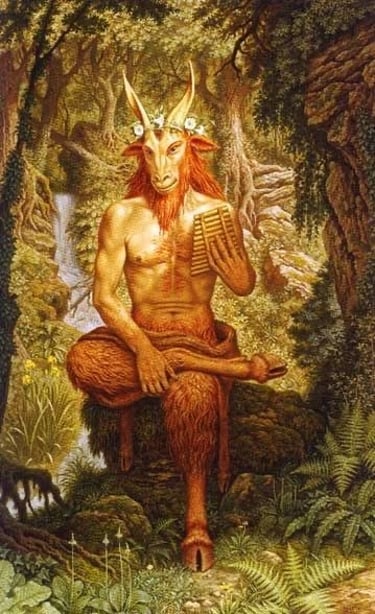
I figured since I just reviewed The God of the Woods, I would make a bonus post on the god of the woods himself-Pan. There are few figures in mythology as fascinating, contradictory, and enduring as Pan, the ancient Greek god of the wild. Half man and half goat, Pan has wandered through forests, folklore, literature, and modern imagination for thousands of years. He is both playful and frightening, beautiful and unsettling-a deity who reminds us that nature is not always gentle (see: balance).
Who Was Pan?
In Greek mythology, Pan was the god of the shepherds, flocks, forests, mountains, and wild places. Often depicted with the legs, horns, and beard of a goat, he spent his days roaming woodlands, playing music on his reed pipes, and watching over the natural world.
Unlike the grand gods who lived on Mount Olympus, Pan belonged to the untamed edges of civilization. He was a god of hidden groves, lonely hillsides, and forgotten paths through the forest.
His very appearance reflected this connection to the wild. While many Greek gods were portrayed as idealized humans, Pan embodied the raw, instinctive side of nature that could not be controlled.
The Origin of Panic
One of the most interesting things about Pan is that his name gave us the word panic.
Ancient Greeks believed that Pan could produce sudden, irrational fear in travelers who wandered through lonely woods or mountains. A rustling in the bushes, an unexpected sound in the darkness, or the feeling that something unseen was watching could all be attributed to Pan's presence.
This "panic" was not necessarily a sign of danger. It was simply the overwhelming realization that humans are not always in control of their surroundings.
Even today, many people can relate to that strange feeling when walking alone in a forest and sensing something ancient and unknowable just beyond sight.
Pan and Music
Pan is also famous for his musical talent.
According to myth, he created the pan flute after pursuing the nymph Syrinx. To escape him, she transformed into reeds. Pan cut the reeds and fashioned them into an instrument whose haunting sound became associated with forests, shepherds, and the natural world.
The music of Pan represents more than entertainment. It symbolizes humanity's connection to nature and the way music can capture emotions that words cannot express (see: reggae music).
Many modern fantasy stories continue to use flute music and woodland melodies as symbols of magic and mystery, a tradition that can be traced back to Pan.
Pan in Literature and Gothic Fiction
Although Pan originated in ancient Greece, he became especially popular in Gothic and supernatural literature.
Writers of the nineteenth and twentieth centuries often reimagined Pan as something darker and more mysterious. Rather than a simple nature god, he became a symbol of the ancient forces that exist beyond human understanding.
One of the most famous examples is Arthur Machen's The Great God Pan, a novella that transformed Pan into a figure of cosmic horror. The story explores forbidden knowledge, hidden realities, and the terrifying possibility that the natural world contains truths humanity was never meant to uncover.
Since then, Pan has appeared in countless fantasy, horror, dark academia, and folk horror stories. He often represents the call of the wilderness, the loss of modern comforts, and the seductive danger of returning to something primal.
Why Pan Still Fascinates Us
Perhaps Pan endures because he represents something many people feel but struggle to describe.
Modern life is filled with screens, schedules, and artificial environments. Pan reminds us of forests untouched by roads, mountains older than history, and instincts buried beneath layers of civilization.
He embodies freedom, mystery, creativity, and the wilderness that still exists within both nature and ourselves.
Whether viewed as a playful shepherd god, a guardian of forests, or a haunting figure of folklore and Gothic fiction, Pan continues to stand at the crossroads between civilization and wilderness and reminds us to touch grass (literally) every once in a while.

Contact
Reach out with your gothic tales and thoughts.
thegothicrasta@gmail.com
Midnight Margians from Savannah, GA
A GothicRasta Blog
© 2025. All rights reserved.